
The History of Cryptography: From Caesar to AES-256 Encrypted Messages
Explore the fascinating evolution of encryption from ancient Rome to the modern technology that lets you send free online encrypted messages with military-grade security.
A Journey Through Time
Today, when you send encrypted messages online for free, you are using technology that represents thousands of years of human ingenuity. The desire to send secure messages is as old as communication itself.
This article traces the remarkable journey from simple substitution ciphers to the sophisticated algorithms that enable you to send free online encrypted messages with complete security.
Ancient Cryptography: The Birth of Encrypted Messages
The Caesar Cipher (100 BC)
Julius Caesar used one of the earliest known encryption methods to send encrypted messages to his generals. The Caesar cipher shifted each letter by a fixed number of positions in the alphabet. For example, with a shift of 3, "ATTACK" became "DWWDFN".
While primitive by today's standards, this was revolutionary for ancient secure messaging. However, this simple substitution cipher could be easily broken, especially compared to how we send encrypted messages online today.
Other Ancient Methods
- Scytale (Sparta, 400 BC): A wooden rod used to decrypt messages written on leather strips.
- Polybius Square (Ancient Greece): Converted letters into numbers for secure messaging.
- Atbash Cipher (Hebrew, 600 BC): Reversed the alphabet so A became Z, B became Y.
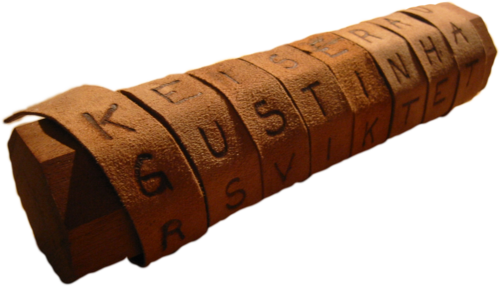
Scytale
Medieval and Renaissance: Advancing Secure Messaging
The Vigenère Cipher (1553)
French cryptographer Blaise de Vigenère created a polyalphabetic cipher that remained unbreakable for 300 years. Unlike Caesar's single shift, Vigenère used a keyword to create multiple shifting patterns.
This represented a massive leap in secure messaging. Diplomats and spies could send encrypted messages with confidence that enemies could not easily decipher them.
The Cipher Disk (1470s)
Leon Battista Alberti invented the cipher disk, a mechanical device with rotating alphabet wheels. It was the first encryption "machine," foreshadowing the mechanical cryptography of the 20th century.
World Wars: Mechanizing Encrypted Messages
The Enigma Machine (1918-1945)
Nazi Germany's Enigma machine represented the pinnacle of mechanical cryptography. With billions of possible settings, it seemed like the ultimate secure messaging system.
However, Allied cryptanalysts at Bletchley Park, led by Alan Turing, eventually cracked Enigma. This breakthrough shortened World War II by an estimated 2-4 years and saved millions of lives.
Security Insight: Enigma's weakness was predictability in its mechanical rotors. Modern cryptography uses mathematical randomness that cannot be predicted or exploited like mechanical systems.
The Computer Age: Digital Encrypted Messages
DES - Data Encryption Standard (1977)
As computers became widespread, the U.S. government needed a standard for secure messaging in the digital age. DES was the first widely adopted digital encryption standard. However, by the 1990s, increasing computing power made DES vulnerable to brute-force attacks.
RSA Public Key Cryptography (1977)
RSA revolutionized cryptography with public-key encryption, allowing secure messaging without needing to share secret keys in advance. It laid the foundation for modern systems where you can send encrypted messages online without prior key exchange arrangements.
Modern Era: AES and Sending Encrypted Messages Online
AES - Advanced Encryption Standard (2001)
After a five-year competition, the U.S. NIST selected Rijndael as the new encryption standard, naming it AES. With key sizes of 128, 192, or 256 bits, AES became the global standard for secure messaging.
When you send encrypted messages online today through services like Cryminal.me, you are using AES-256-GCM, the strongest variant of this algorithm. This represents the culmination of 2,000+ years of cryptographic innovation.
Unbreakable Security: AES-256 would take 1000+ years to crack even with future supercomputers
Efficiency: Encrypt messages in milliseconds while maintaining maximum security
Universal Standard: Used by governments, militaries, and secure messaging platforms worldwide
Accessible: Now available for anyone to send encrypted messages online for free
The Future: Quantum-Proof
As quantum computers develop, cryptographers are already working on post-quantum encryption algorithms. While AES-256 remains secure against quantum attacks, the next generation of cryptography will ensure we can continue to send encrypted messages online safely for decades to come.
Cryptography Timeline
You Are Part of Cryptography History
When you send encrypted messages online today, you are participating in a tradition that spans millennia. From Caesar's military dispatches to your private conversations, the fundamental need for secure messaging connects us across time.
The difference? You can now send free online encrypted messages with security that surpasses anything available to kings, generals, or spies throughout most of human history.
Send Your First Encrypted MessageRelated Topics: